The Parish Is Where the Church Lives
In September 2025, the Archdiocese of Singapore launched its ten-year pastoral plan, Communion in Mission. Its five priorities — lifelong formation, building communities of faith, differentiated co-responsibility, unity in diversity, and embracing synodality — offer a compelling vision of who we are called to become as Church.
Author: Leonard Koh
Why Pastoral Conversion Begins Locally and Why That Changes Everything
In September 2025, the Archdiocese of Singapore launched its ten-year pastoral plan, Communion in Mission. Its five priorities — lifelong formation, building communities of faith, differentiated co-responsibility, unity in diversity, and embracing synodality — offer a compelling vision of who we are called to become as Church.
Yet every pastoral plan must eventually answer a simple question: where does this vision take flesh?
Strategies matter. Frameworks are necessary. But the Church does not live on paper. The Church lives in parishes.
This is the first in a series exploring what pastoral conversion actually requires of parish leaders — not as abstract theology, but as a working diagnosis you can apply to your own parish this year.
When we speak about renewing the Church, our thinking often moves quickly to scale: archdiocesan strategies, structural reforms, governance changes. The language becomes large and abstract, and the task can begin to feel overwhelming. Yet renewal rarely begins in abstraction. It begins where the Church actually lives. It begins in the parish.
Not because the parish is simply the smallest administrative unit of the Church, but because it is where the life of the Church becomes concrete. If Communion in Mission is to move beyond aspiration, it must be embodied in parish life.
This is why pastoral conversion matters.
The Parish Is Not a Branch Office
The parish is not a department of a larger institution. It is not a sacramental service centre. It is not merely a geographic boundary for Sunday Mass.
The parish is the Church in miniature.
What the universal Church is called to be — worshipping, evangelising, disciple-making, living in communion — the parish is called to embody locally. It is the People of God made visible in a particular neighbourhood.
In Singapore, that neighbourhood might be an HDB estate, a mature housing town, or a rapidly developing district. Around every parish church are families, migrant workers, elderly residents, students, and people of many faiths or none at all. The parish stands quietly in the middle of this everyday life as a visible sign of the Church.
This is not poetic language. It is ecclesiological reality.
If the Church is struggling, it will be visible in the parish. If the Church is vibrant, it will be evident in the parish. If the Church is missionary, it will be embodied in the parish.
The health of the Church is not primarily measured in documents or policies. It is revealed in parish life. Look at your own parish for a moment: if a newcomer spent one Sunday there, what would they conclude the Church actually is?
Why Church Renewal Can Feel Overwhelming
When we speak about transforming an entire archdiocese, the scale can feel paralysing.
Even in a relatively small diocese like Singapore, the system is complex. Our parishes are diverse. Some are long-established communities; others are growing quickly alongside new housing estates. Each parish carries its own history, culture, and pastoral realities.
At times, it can feel as though we are trying to change everything all at once. But once we recognise that the parish is the Church in miniature, the starting point becomes clearer.
Renewal begins locally.
The parish is where faith is baptised, formed, celebrated, challenged, and lived. It is where marriages are strengthened, where young people wrestle with vocation, where the elderly seek consolation, and where seekers tentatively cross the threshold of faith.
For most Catholics in Singapore, the parish is not an abstract idea. It is the community where they attend Mass each week, where their children receive the sacraments, and where faith becomes part of everyday life.
Which means this: if renewal does not reach the parish, renewal has not reached the Church.
The Parish as Lived Ecclesiology
We can articulate a beautiful theology of the Church — communion, mission, synodality. But unless that theology takes flesh in parish life, it remains rhetoric.
Ask these questions of your own parish, honestly: is the parish a place of welcome or indifference? Is it inward-focused or outwardly sent? Are relationships marked by trust and charity, or by fragmentation and competition? Do leaders collaborate as disciples, or function as siloed managers?
These are not theoretical questions. They shape the everyday experience of the Church, and your honest answers to them are a more accurate diagnostic than any parish statistic.
The parish is where doctrine becomes culture, where theology becomes behaviour, and where mission becomes either real or merely aspirational.
Pope Francis expresses this clearly when he writes: “The parish is not an outdated institution… it can assume quite different contours depending on the openness and missionary creativity of the pastor and the community” (Evangelii Gaudium, 28).
In other words, the parish is not fixed. It is meant to be continually renewed for today’s mission.
From Maintenance to Mission
Over time, many parishes drift into maintenance mode.
Energy is spent sustaining existing structures, serving those already present, and preserving what has been inherited. Sacraments are celebrated. Ministries function. Communities gather. Much good is done in this way.
But maintenance is not mission.
Two quick diagnostics can help reveal which mode your parish is actually in. A parish in maintenance mode measures success by attendance, stability, and continuity: are people still coming? A missionary parish measures faithfulness by whether the Gospel is transforming lives within and reaching beyond its walls: are people being changed, and is anyone new being reached?
If your parish leadership meetings mostly ask the first question and rarely the second, that is itself diagnostic.
In a dense and highly connected society like Singapore, the parish sits within neighbourhoods filled with people who may never have encountered Christ personally. Families live just blocks away from the church building yet remain strangers to the life of the Church.
Pastoral conversion begins with recognising this reality.
A parish is not primarily a place where Catholics receive religious services. It is a community sent by Christ into its neighbourhood. And in Singapore’s multi-religious society — where neighbours may be Buddhist, Muslim, Hindu, free-thinkers, or seekers of many kinds — this missionary presence must be expressed with humility, witness, and genuine friendship.
The parish exists not only for those who gather within it, but also for those who have not yet encountered the love of God.
Until this shift occurs, structural reforms will only rearrange the furniture.
Renewal That Is Personal
At the parish level, we are not dealing with charts or strategy decks. We are dealing with relationships, histories, wounds, and hopes. Many parish leaders have served faithfully for decades. Communities carry deep memories. Culture cannot be changed by decree. It must be transformed from within.
Yet this is also why parish renewal is powerful.
When leaders grow in clarity of mission, when communities rediscover their identity, when relationships are healed, when prayer deepens, and when the courage to evangelise increases, the effects ripple outward — not because of directives, but because of lived witness.
Parish renewal is not thinking small. It is working where the Church becomes tangible.
Where to Begin
If you lead in a parish, three starting moves are more useful than any grand plan.
First, name the mode. Sit with your core leadership team and ask honestly, using the diagnostic above, whether your parish is currently in maintenance mode or mission mode. Do not rush to the comfortable answer.
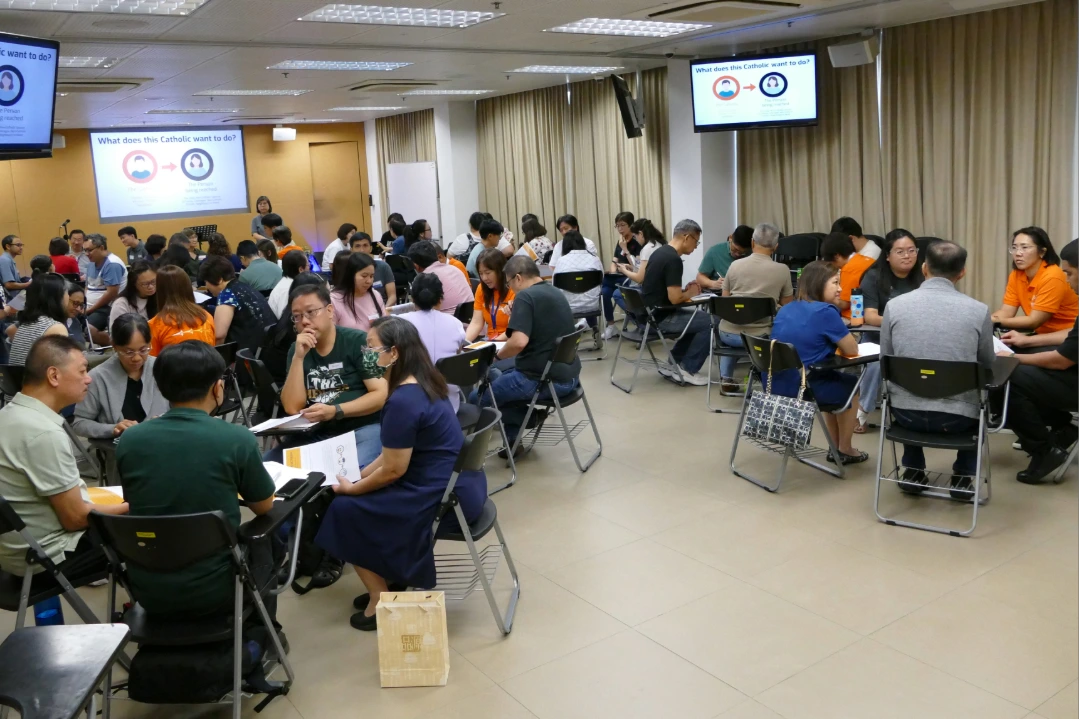
Second, have one honest conversation. Choose one ministry or leadership meeting in the next month and ask directly: are we serving only those already here, or are we also reaching those who are not? Let the silence, if there is any, be informative rather than uncomfortable.
Third, look outward once. Identify one relationship your parish does not yet have with its immediate neighbourhood — a block, a community, a group of neighbours — and take one small, concrete step towards it before the next parish feast.
None of these require a strategy document. They require attention.
A Realistic and Hopeful Starting Point
If the parish is the Church in miniature, then parish pastoral conversion is not an optional initiative. It is the most realistic and hopeful starting point for the renewal of the whole Church.
We do not renew the Church by bypassing the parish. We renew the Church by helping parishes become fully themselves.
The question is not whether the Church needs renewal. The real question is this: are we willing to focus our energy where the Church actually lives?
Because when the parish lives as Church — missionary, relational, spiritually alive — the Church truly lives.
And that is where renewal begins.